Generation of Computer 1st to 5th and How Systems Evolved
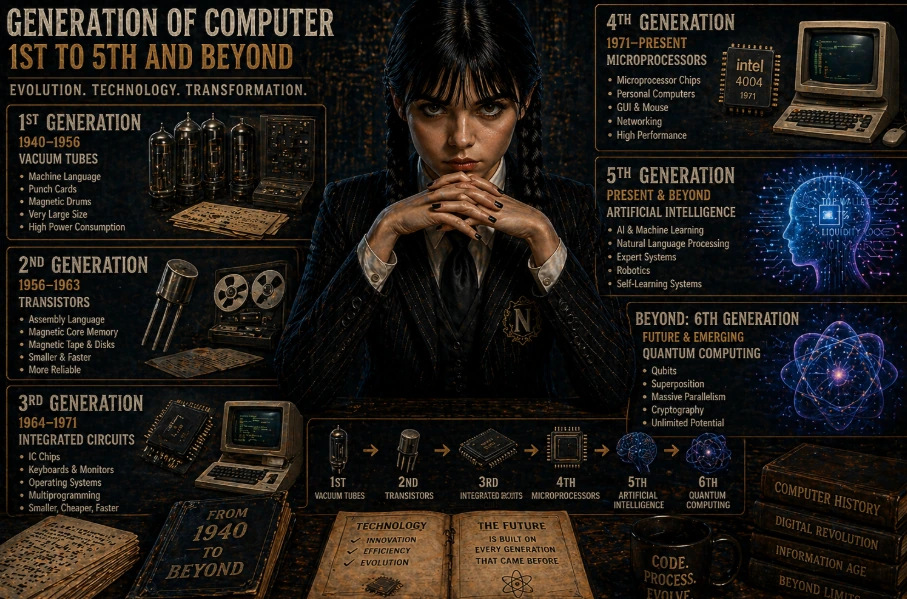
The generation of computer 1st to 5th explains how computing moved from room-sized vacuum tube machines to artificial intelligence systems that process language, images, transactions, and real-time decisions. Each generation is defined by a major hardware shift, but the real story is wider: every stage changed how data was stored, how instructions were written, how users interacted with machines, and how reliable systems became.
For a modern reader, this timeline is not just academic history. It helps explain why older systems were expensive and fragile, why personal computers became possible, and why today’s AI-driven platforms require huge amounts of data and processing power. From Wednesday’s perspective, the useful lesson is structural: every computing generation solved one bottleneck while creating a new one.
What Defines a Generation of Computers
A computer generation is usually classified by the dominant technology used for processing and memory. The shift from one generation to the next happens when a new component removes a major limitation of the previous design. Vacuum tubes made early electronic computing possible, but they were hot, large, and unreliable. Transistors solved much of that problem. Integrated circuits then made systems smaller and faster. Microprocessors moved computing into homes, offices, and mobile devices.
The classification also depends on software and user interaction. A machine built with vacuum tubes required machine language and punched cards. A microprocessor-based computer could run operating systems, graphical interfaces, and general-purpose applications. An AI-oriented system can process natural language, detect patterns, and adapt through trained models.
The main attributes used to compare generations are:
- core processing technology;
- memory and storage method;
- programming model;
- physical size and power use;
- speed and reliability;
- user interface and accessibility.
This makes the topic practical. If you understand the generation, you understand the machine’s limits. A first-generation system was not slow because engineers lacked ambition. It was slow because the hardware, memory, heat profile, and programming model created hard restrictions.
First Generation of Computer: Vacuum Tube Systems
The first generation of computers, usually dated from the 1940s to the mid-1950s, used vacuum tubes as the main electronic switching component. These machines were massive, expensive, and difficult to maintain. They generated intense heat, consumed large amounts of electricity, and needed constant technical supervision.
Programming was also extremely difficult. Instructions were written in machine language, meaning binary commands directly understood by the hardware. Input often came through punched cards or paper tape, and output was printed rather than displayed on a screen. Setting up one task could take hours or days.
Examples such as ENIAC and UNIVAC show the scale of this generation. They were powerful for their time, but limited by today’s standards. Memory capacity was small, failure rates were high, and systems were usually built for specific scientific, military, or administrative tasks.
The practical verdict is clear: the first generation proved that electronic computing could work, but it was not yet scalable for ordinary users or businesses.
Second Generation of Computer: Transistor-Based Systems
The second generation, from the mid-1950s to the early 1960s, replaced vacuum tubes with transistors. This was one of the most important changes in computing history because transistors were smaller, faster, more reliable, and used less power. Heat was still a concern, but the failure rate dropped sharply compared with vacuum tube machines.
This generation also improved memory and storage. Magnetic core memory became common, and magnetic tapes and disks allowed more stable data handling. Systems became more useful for business, science, and government because they could run longer and process tasks more efficiently.
The software environment also changed. Assembly language replaced pure machine code for many tasks, making programming more manageable. High-level languages such as FORTRAN and COBOL began to appear, which allowed programmers to write instructions closer to human logic rather than raw hardware commands.
For users, the second generation made computers less like experimental machines and more like operational tools. They were still expensive and large, but they were more dependable and easier to program.
Third Generation of Computer: Integrated Circuits
The third generation, generally placed between 1964 and 1971, introduced integrated circuits. Instead of using individual transistors separately, engineers placed multiple transistors and electronic components onto a single silicon chip. This reduced size, increased speed, and improved reliability.
Integrated circuits allowed computers to become more compact and commercially practical. Businesses could use them for accounting, inventory, banking, and data processing. Scientific institutions could run more complex calculations with greater stability.
User interaction improved during this period. Keyboards and monitors became more common, and operating systems allowed better management of programs and resources. Instead of running one task in a rigid sequence, systems could support multiprogramming, where several jobs were managed more efficiently.
The main shift was density. More computing power could fit into less space. That changed the economics of computing. Systems were still not personal devices, but they were moving closer to broader institutional use.
Fourth Generation of Computer: Microprocessor Era
The fourth generation began in the 1970s and continues as the foundation of most modern computing. Its defining technology is the microprocessor, where the central processing unit is placed on a single chip. The Intel 4004 is commonly associated with the beginning of this era.
The microprocessor changed everything because it made computing smaller, cheaper, and more flexible. Personal computers became possible. Offices began using desktops for documents, spreadsheets, databases, and communication. Later, laptops, smartphones, embedded systems, and networked devices expanded the same logic.
This generation also introduced major changes in user experience. Graphical interfaces, mouse input, personal software, local storage, and networking made computers accessible to non-specialists. The internet then connected systems globally and turned computers into communication, commerce, and media platforms.
From Wednesday’s analytical view, the fourth generation is where computing becomes infrastructure. It no longer serves only institutions. It becomes part of payment systems, online gaming, crypto platforms, banking, logistics, and daily decision-making.
Fifth Generation of Computer: Artificial Intelligence Systems
The fifth generation focuses on artificial intelligence, natural language processing, machine learning, and systems that can work with patterns rather than only fixed instructions. Unlike earlier generations, the fifth is not defined by one single hardware component. It is defined by the combination of advanced processors, large datasets, parallel computing, neural networks, and adaptive software.
AI systems can classify images, understand speech, generate text, detect fraud, recommend content, support autonomous vehicles, and analyze financial behavior. These tasks require more than traditional rule-based programming. They depend on training models with data, then using those models to make predictions or generate outputs.
The limitation is that AI systems are data-hungry and computationally expensive. Their quality depends on training data, model architecture, hardware acceleration, and continuous evaluation. A weak dataset can create unreliable results even when the hardware is strong.
This generation marks a different kind of computing. Earlier systems followed explicit instructions. AI systems often infer patterns. That makes them powerful, but also harder to audit and explain.
Comparison of Generation of Computer 1st to 5th
A direct comparison helps show how each stage solved a specific problem and created the basis for the next one.
| Generation | Main Technology | Approx. Period | Main Improvement | Key Limitation |
| First | Vacuum tubes | 1940-1956 | Electronic calculation | Heat, size, failure rate |
| Second | Transistors | 1956-1963 | Better reliability | Still large and costly |
| Third | Integrated circuits | 1964-1971 | Smaller, faster systems | Limited personal access |
| Fourth | Microprocessors | 1971-present | Personal and networked computing | System complexity |
| Fifth | AI systems | Present and beyond | Pattern recognition and automation | Data and compute dependency |
The table shows that progress is not only about speed. Each generation changes who can use computers, what problems they can solve, and how much infrastructure is needed to support them.
Why the Evolution Still Matters Today
Understanding generations of computer helps explain modern technology decisions. A smartphone, a cloud server, an AI model, and a crypto payment platform all depend on decades of progress in processing, memory, networking, and software design. The current digital economy is built on those layers.
The history also prevents a common mistake: treating technology as sudden innovation. AI did not appear from nowhere. It became practical because earlier generations reduced hardware size, increased processing speed, improved storage, connected networks, and made large-scale computation affordable.
For students, this framework helps classify systems clearly. For professionals, it explains why architecture matters. For ordinary users, it gives a simple way to understand why today’s devices are faster, smaller, and more intelligent than the machines that started electronic computing.
The practical takeaway is that the generation of computer 1st to 5th is a roadmap of problem-solving. Each stage removed a barrier: heat, size, cost, programming difficulty, accessibility, or intelligence. The next stage of computing will follow the same pattern by solving today’s limits in energy use, AI reliability, quantum processing, and data control.