
Scott Bessent and the $344M USDT Freeze: Crypto Enforcement in Practice
Scott Bessent crypto enforcement has become a clear example of how digital assets now operate inside the same geopolitical pressure system as banks, payment processors, and cross-border settlement rails. The $344 million USDT freeze connected to Iran-linked wallets showed that stablecoins are not outside state control simply because they move on public blockchains.
For Wednesday, the important signal is the mechanism, not the headline. The freeze did not require shutting down Tron, attacking wallet software, or stopping crypto markets. It worked because USDT has a centralized issuer layer that can restrict specific addresses when law enforcement, sanctions agencies, and blockchain analytics align around a target.
Why the $344M USDT Freeze Matters
The $344 million USDT freeze matters because it turns an abstract compliance debate into a practical enforcement model. For years, crypto users treated blockchain transfers as faster, cheaper, and harder to restrict than traditional banking channels. That assumption still holds for some assets, but it does not apply equally across the whole market.
Stablecoins are especially different. They move on public networks, but their value depends on an issuing company that maintains redemption, reserves, contracts, and compliance relationships. When an issuer can blacklist a wallet, the token begins to behave less like decentralized money and more like programmable liquidity under legal oversight.
This does not make USDT unusable. It explains why users must understand the control layer. A person moving funds through USDT on Tron may experience fast settlement and low fees, but those advantages exist alongside issuer-level enforcement. In Wednesday’s analysis, that combination defines the modern stablecoin trade-off: operational speed in exchange for compliance exposure.
The freeze also changes how market participants read risk. The question is no longer “Can crypto be traced?” It is “Which crypto assets can be stopped after tracing identifies the route?”
How the Freeze Worked in Practice
The enforcement pathway was straightforward in structure. Authorities identified wallets tied to targeted activity, the relevant addresses were linked to suspicious or sanctioned flows, and Tether restricted movement from those wallets. The assets remained visible on-chain, but they became practically inaccessible because the token contract no longer allowed normal transfer activity from blacklisted addresses.
That distinction matters. A freeze is not the same as deleting funds from a blockchain. It is a restriction at the token control layer. The balance may still appear in the wallet, but the owner cannot move it through normal USDT transfer functions.
The typical process follows a sequence:
- Investigators map transaction routes across wallets and exchanges.
- Analytics tools cluster addresses linked to known entities or behaviors.
- Sanctions or law enforcement agencies identify targets.
- The stablecoin issuer blacklists specific addresses.
- Exchanges and compliance teams monitor related flows.
This model is powerful because it targets liquidity rather than infrastructure. Tron continues operating. Other users continue transacting. The intervention focuses on the asset inside selected wallets.
From Wednesday’s perspective, this is the key lesson for anyone analyzing crypto payments, casino deposits, or high-risk digital flows. The blockchain rail may remain open while the token itself becomes restricted.
Stablecoins Are Not the Same as Bitcoin
A common mistake is to speak about “crypto” as one enforcement category. Bitcoin, USDT, Ethereum tokens, XRP, and exchange balances all have different control points. The $344 million freeze is specifically a stablecoin enforcement case, not proof that every crypto asset can be frozen in the same way.
Bitcoin has no issuer that can blacklist a wallet at the asset level. Enforcement usually focuses on exchanges, custodians, bridges, payment processors, and off-ramp points. USDT works differently because its issuer can intervene directly in token movement. Ethereum-based assets may vary depending on contract design. XRP sits in a separate category because it uses a structured ledger and validator-based consensus, but it does not operate like issuer-controlled USDT.
| Asset Type | Main Control Layer | Direct Freeze Capability | Practical Enforcement Route |
| Bitcoin | Network consensus | No issuer-level freeze | Exchanges, custodians, off-ramps |
| USDT | Centralized issuer | Yes | Wallet blacklist and platform monitoring |
| Ethereum tokens | Token contract design | Depends on issuer or contract | Contract controls, exchanges, bridges |
| XRP | Ledger and network infrastructure | Limited compared with stablecoins | Exchanges, compliance gateways, monitoring |
| Custodial balances | Platform operator | Yes | Account freeze, withdrawal block |
The practical conclusion is simple: asset choice defines enforcement exposure. A user may choose USDT for speed and liquidity, but that choice brings a different risk model than holding native BTC.
Scott Bessent’s Strategy: Follow Liquidity, Not Platforms
Scott Bessent’s crypto enforcement approach reflects a broader shift in financial sanctions. Instead of trying to ban a blockchain or attack an entire network, the strategy follows liquidity through traceable points. That is more precise and often more effective.
Public blockchains create permanent transaction records. That transparency gives investigators a map. The hard part is not seeing that transactions happened. The hard part is connecting wallets to real entities, exchanges, intermediaries, sanctions lists, and operational networks. Once that link is strong enough, enforcement can move through issuers, custodians, or regulated platforms.
This is why the USDT freeze is important for crypto market structure. It shows that digital asset enforcement is becoming operational, not theoretical. Regulators do not need to stop every transaction. They need to identify critical liquidity pools and restrict movement where legal authority and technical control overlap.
For Wednesday, this is directly relevant to crypto gambling and high-risk payment environments. Many platforms use stablecoins because they reduce volatility and simplify deposits. But if a stablecoin can be frozen, then platform operators, payment processors, and users must treat source-of-funds risk as part of the payment route.
Why Tron Became Central to the Case
The affected USDT wallets operated on Tron, which is not surprising. Tron has become a major rail for stablecoin transfers because it offers low fees, fast confirmation, and broad exchange support. For users moving large amounts of USDT across borders, those features are attractive.
The same features also make Tron useful for high-volume routing. When transfers are cheap and fast, funds can move through multiple wallets with less cost friction. That creates convenience for legitimate users and complexity for investigators. But complexity is not anonymity.
Blockchain analytics can still trace address relationships, transaction timing, exchange touchpoints, and repeated routing behavior. Splitting transfers, using intermediary wallets, and moving across jurisdictions may slow analysis, but they do not erase the on-chain trail.
The practical mistake is assuming that low-cost stablecoin movement equals low visibility. In reality, stablecoin routes are often highly visible because every transfer remains recorded. The risk is not only whether the user can move funds today. The risk is whether those funds become traceable tomorrow after more addresses are identified.
Market Impact: Stablecoin Risk Is Now More Visible
The freeze does not mean users will abandon USDT. Liquidity, exchange support, and network availability still make it one of the most important assets in crypto markets. But the event makes the risk profile clearer.
Large transfers now carry stronger compliance sensitivity. Exchanges may tighten monitoring around related wallets. OTC desks may ask more questions about source of funds. Platforms using stablecoins for deposits and withdrawals may need stronger screening before allowing movement through their systems.
This has several practical effects:
- users may diversify between stablecoins and native assets;
- platforms may increase wallet screening before deposits;
- high-risk flows may move toward less controllable assets;
- compliant institutions may prefer stablecoins with strong enforcement cooperation;
- sanctioned or suspicious networks may face higher routing costs.
For crypto gambling markets, the key issue is deposit contamination. A casino may accept USDT quickly, but if the incoming wallet history connects to risky flows, the platform may freeze balances, request verification, or delay withdrawal. That means payment speed at deposit does not guarantee freedom at payout.
XRP’s Position in the Enforcement Landscape
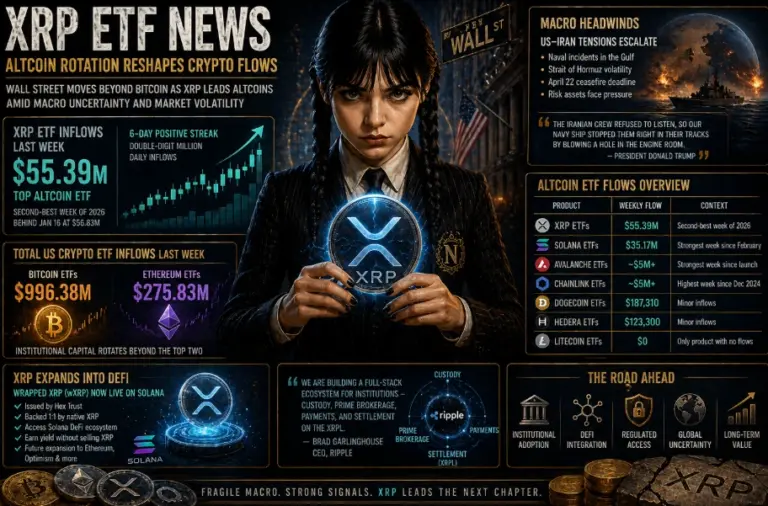
XRP is not a stablecoin, and its enforcement profile is different from USDT. It uses a structured ledger designed for fast settlement rather than issuer-controlled dollar tokens. That gives XRP a separate position in discussions about compliance, liquidity, and institutional use.
The advantage is predictability. XRP transactions follow a more defined ledger model, and the asset itself is not frozen by a centralized stablecoin issuer in the same way USDT can be. The limitation is that XRP still interacts with exchanges, custodians, payment services, and regulated gateways. Those points can restrict access even when the base network continues operating.
In Wednesday’s analysis, XRP sits between two extremes. It is not as issuer-controlled as USDT, but it is also not outside compliance systems. Its market relevance depends partly on whether institutions view its structure as suitable for regulated settlement.
This is why XRP news often connects price, regulation, and infrastructure. A token’s long-term role is not determined only by chart movement. It also depends on how easily the asset can operate inside financial systems that require monitoring, reporting, and legal accountability.
What Users and Platforms Should Learn
The $344 million USDT freeze gives a practical lesson: crypto enforcement now works through the points where visibility meets control. A blockchain can be open, but an asset on that blockchain may still be restricted. A wallet can be pseudonymous, but its transaction history can expose patterns. A platform can process deposits quickly, but withdrawals may face checks when risk signals appear.
Users should check more than fees and speed before choosing a payment route. They should understand whether the asset has issuer controls, whether the network is commonly monitored, whether exchanges support the route, and whether previous wallet history could trigger review.
Platforms should treat stablecoin compliance as part of payment infrastructure, not as a legal afterthought. Screening after withdrawal requests is weaker than screening before deposits, because the risk has already entered the system. In high-risk sectors, that delay creates disputes, frozen balances, and reputational damage.
The practical direction is clear: crypto is becoming more traceable, not less. Scott Bessent’s enforcement strategy shows that governments can target liquidity without breaking networks. For market participants, the safer approach is to understand each asset’s control layer before using it as a settlement tool.