XRP ETF News and the Shift Toward Altcoin Capital Rotation
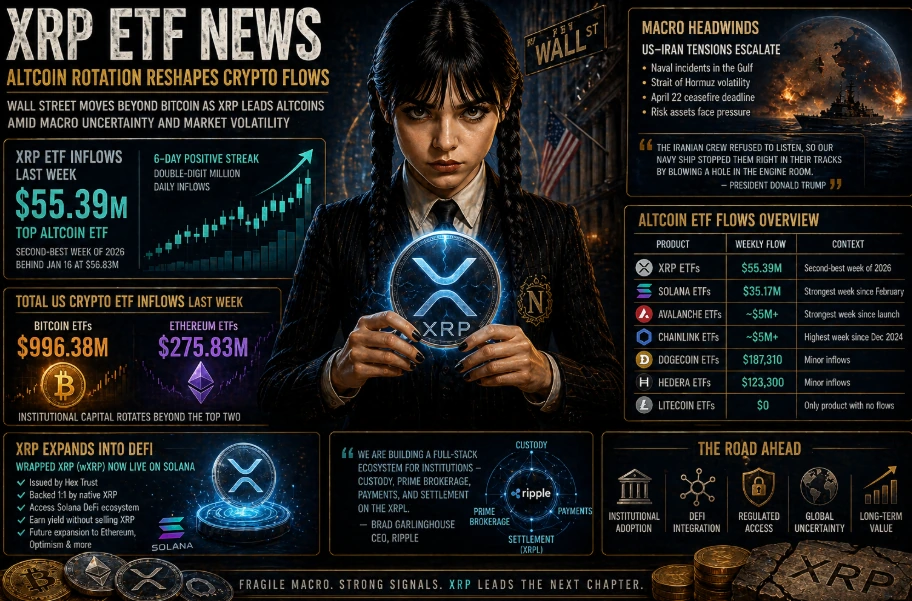
XRP ETF news is no longer just a side topic for altcoin traders. Recent market reports show XRP-linked products attracting strong inflows, with one widely circulated weekly figure near $55.4 million and broader 2026 data pointing to sustained institutional attention around XRP exposure.
The practical verdict is clear: XRP is being evaluated less like a legacy altcoin and more like a liquidity instrument inside a wider institutional rotation. That does not remove price risk. It changes the reason capital is entering. From Wednesday’s perspective, the signal is not “XRP is guaranteed to rise.” The signal is that regulated access, payment utility, and DeFi expansion are starting to matter more than simple market hype.
Why XRP ETF News Matters Now
The strongest part of the current XRP ETF story is consistency. One week of inflows can be noise. A longer pattern of positive capital movement suggests that allocators are not only reacting to headlines but testing exposure through regulated products. Yahoo Finance reported that XRP ETFs logged their strongest month of 2026 in April, with cumulative total net inflows around $1.29 billion and total net assets near $1.06 billion.
For institutional capital, ETFs solve a basic operational problem. A fund manager can gain exposure without setting up wallets, managing private keys, handling on-chain transfers, or building internal custody workflows. That accessibility matters because many institutions are not avoiding crypto only because of volatility. They are avoiding the operational friction around direct asset handling.
This is why XRP ETF news should be read as infrastructure news, not just price news. The ETF wrapper gives traditional capital a cleaner route into XRP. When money enters through that wrapper, the flow becomes easier to track, compare, and rebalance.
Capital Rotation Is Becoming More Selective
Earlier crypto cycles were usually dominated by Bitcoin first, Ethereum second, and everything else as speculative overflow. The current ETF environment looks more segmented. Capital is still concentrated in larger assets, but altcoin allocation is becoming more deliberate.
The reported XRP inflow figure near $55.4 million placed it ahead of other altcoin products in that weekly window, while Solana also attracted meaningful capital. Smaller flows into assets such as Avalanche and Chainlink show that investors are not buying every altcoin equally. They are choosing based on liquidity, narrative, perceived utility, and market access.
That selection process matters. If capital were moving randomly, old names and low-conviction assets would receive similar attention. Instead, XRP benefits from a clear institutional story: settlement, payments, liquidity routing, and regulatory-market relevance.
A simple comparison captures the allocation logic:
| Asset Segment | Institutional Appeal | Main Risk Signal |
| XRP | Payments, settlement, ETF access | Regulatory and flow sensitivity |
| Solana | DeFi, applications, high-speed execution | Network and valuation volatility |
| Avalanche | Infrastructure and subnet ecosystem | Lower relative inflow depth |
| Chainlink | Oracle and data infrastructure | Utility strong, but less retail urgency |
| Litecoin | Legacy payment asset | Weak current narrative momentum |
The table does not rank assets as good or bad. It shows why ETF capital is becoming more selective. Money is moving toward assets with a current reason to exist inside portfolios.
XRP’s Institutional Narrative Is Built Around Payments
XRP’s strongest narrative has always been payments and settlement. Unlike many tokens that depend mainly on community attention, XRP has a functional story tied to cross-border transfer, liquidity bridging, and financial infrastructure. Investors may disagree on how large that use case can become, but the narrative is easy to understand.
That clarity helps ETF demand. A fund manager does not need to explain XRP as a meme, a game token, or a general-purpose smart contract bet. The asset can be framed as exposure to blockchain-based payment rails and liquidity infrastructure.
From Wednesday’s perspective, this is where XRP differs from many speculative altcoins. The strongest assets in institutional rotation usually have a clean operational argument. XRP’s argument is not that every bank will use it tomorrow. The argument is that if blockchain settlement expands, XRP already occupies a recognizable position in that discussion.
The limitation is also clear. Narrative alone does not guarantee adoption. ETF inflows can support market structure, but long-term strength still depends on real liquidity use, regulatory clarity, custody confidence, and consistent demand beyond short-term flow cycles.
How ETF Flows Can Affect XRP Price Structure
ETF inflows do not always move price immediately, but they can influence market structure. If a spot-linked product receives new capital, the issuer or market structure around the product may require exposure to underlying XRP. That can create buy pressure, reduce freely available supply, or improve confidence around liquidity.
The effect depends on scale. A small inflow may be absorbed easily by the market. A larger inflow can stabilize price during weak periods or add pressure during a breakout attempt. The reverse is also true. If sentiment changes and ETF products begin recording outflows, that pressure can move against XRP quickly.
ETF-driven markets usually operate through three layers:
- Primary flow: investors put money into the product.
- Underlying exposure: the product structure requires XRP exposure or custody.
- Market feedback: traders respond to visible inflow data and adjust positioning.
The third layer is often underestimated. Sometimes the flow itself is less important than how traders interpret it. A sustained inflow streak can attract additional buyers because it suggests institutional confidence. A sudden outflow can do the opposite.
For Wednesday, the useful trading lesson is to avoid treating ETF inflow as a standalone buy signal. It should be checked against price reaction, volume quality, Bitcoin conditions, and broader risk appetite.
wXRP on Solana Expands the Utility Layer
A major development behind the broader XRP discussion is wrapped XRP access on Solana. Coindesk and The Block reported in April 2026 that wXRP launched on Solana through Hex Trust custody and LayerZero cross-chain infrastructure, allowing XRP exposure to interact with Solana DeFi applications.
This matters because XRP’s native use case has historically been tied to payments and settlement. Wrapped XRP gives holders a route into DeFi activity such as swaps, liquidity pools, and yield-related strategies, depending on the platforms they use. That expands the asset’s surface area.
The mechanism is simple in concept. Native XRP is held or represented through a custody and bridge structure, while wrapped tokens circulate on another chain. Users can then deploy that wrapped version in applications where native XRP would not normally operate.
The risk is that wrapped assets add new control points. Custody, bridge security, smart contract execution, liquidity pools, and redemption mechanics all matter. A holder may gain DeFi access but also accept technical and counterparty risk that does not exist in the same way when holding native XRP.
Solana and XRP Are Not Direct Substitutes
The XRP-Solana relationship is more interesting as convergence than competition. XRP is associated with settlement and liquidity movement. Solana is associated with high-speed applications, DeFi, trading, and consumer-facing crypto activity. The two systems solve different problems.
That distinction explains why institutions may allocate to both. XRP gives exposure to payment infrastructure. Solana gives exposure to application-layer growth. In a portfolio, those narratives can coexist rather than cancel each other out.
The wXRP bridge strengthens that coexistence. XRP can enter Solana’s active DeFi environment, while Solana gains another recognizable asset with strong market liquidity. The result is not a merger of ecosystems. It is a liquidity connection between different blockchain functions.
The practical mistake would be assuming that DeFi access automatically increases XRP’s value. Utility expands only if users actually provide liquidity, borrow, lend, trade, or build integrations around wXRP. Without activity, the bridge remains a technical feature rather than a demand engine.
Macro Pressure Makes Regulated Crypto Access More Attractive
XRP ETF news also sits inside a larger macro environment. When markets face geopolitical tension, inflation uncertainty, rate-policy changes, or liquidity stress, investors often rebalance risk rather than exit risk completely. Crypto ETFs can become a controlled way to maintain exposure without direct custody.
This is why ETFs matter during unstable periods. They let investors adjust positions quickly inside familiar brokerage and fund structures. That does not make XRP a safe haven in the traditional sense. It means XRP can function as a defined risk allocation rather than an operationally messy crypto position.
For allocators, the benefit is control. They can increase exposure when flows and momentum improve, reduce exposure when regulation or volatility worsens, and compare XRP against other liquid assets inside a portfolio model.
Wednesday treats this as a maturity signal. Crypto markets are moving away from pure wallet-native participation and toward layered access: spot markets, ETFs, custody platforms, wrapped assets, and DeFi routes. XRP now touches several of those layers.
Main Risks Behind XRP ETF Exposure
Strong inflows do not remove the main risks. XRP remains volatile, regulatory-sensitive, and highly dependent on market liquidity. ETF access may reduce custody friction, but it does not protect investors from price decline.
There is also concentration risk. If inflows become crowded over a short period, sentiment can reverse quickly. Traders who buy only because ETF flows look strong may be exposed when the next data point weakens.
The main risk areas are:
- sudden ETF outflows after a strong inflow streak;
- regulatory changes affecting product availability;
- XRP price failing to respond despite positive flows;
- wrapped-asset bridge or custody concerns around wXRP;
- Bitcoin-led market weakness suppressing altcoin momentum.
The most useful approach is to separate structure from excitement. ETF inflows show interest. They do not guarantee a trend. wXRP expands utility. It does not remove technical risk. Institutional allocation improves credibility. It does not eliminate volatility.
Practical Outlook for XRP ETF News
The current XRP ETF cycle suggests a more mature form of altcoin capital rotation. Investors are no longer looking only at broad crypto exposure. They are evaluating specific assets through product access, liquidity depth, use case clarity, and infrastructure expansion.
XRP’s advantage is that it now has several narratives working at once: ETF inflows, payment infrastructure, institutional access, and DeFi expansion through wrapped versions on Solana. The risk is that the market may price those narratives faster than real usage develops.
For readers tracking XRP ETF news, the best next step is to monitor three signals together: whether inflows continue, whether price confirms demand with stronger structure, and whether wXRP activity on Solana grows beyond launch attention. If those signals align, XRP’s institutional case becomes stronger. If they separate, the market is likely trading narrative more than durable demand.